Category: Activities

  • Cold Weather Cycling

    It’s been cold over the last couple of weeks, colder that it’s been all winter so far with temperatures in the mid -20°C and windchill putting it in the mid -30°C. These lower temperatures have brought some stress and challenges to cycle commuting both for me and the bike.

    One of the first mornings where there as some nasty windchill I got a little frost bite on some exposed skin on my cheek. I tried a couple of different balaclavas but nothing was really working for me. The ones that covered everything also covered my mouth, making it hard to breath. Then I read a blog post about layering. I knew about layering for jerseys and pants etc. but this blog post described how the rider layered various bits of headgear to meet the demands of colder temperatures. The next day I teamed up my heavy balaclava with a headband, positioning the headband just below my eyes, over the nose and down to the top of the lip. That, in combination with ski googles, resulted  in no more exposed skin and some comfortable riding in the wicked temperatures.

    With the rider part of the equation fixed up another problem came to the forefront. One morning, about 5 minutes into the ride, the chain seems to fall off and get stuck between the tire and the rear chain stay. I put it back on and we’re under way for a few minutes, and then it happens again. Now I’m paying attention. It seems that the rear freewheel cassette is not spinning freely enough and when I stop pedeling the cassette keeps rotating and forcing he chain forward against the now stopped big ring, causing it to get all caught up between the tire & chain stay. For the next few days I ride without stopping peddling to keep tension on the chain. It’s a little weird peddling and braking at the same time and every once in a while I’d forget and get the quick reminder with the clatter of the chain dangling down.

    Being big on looking after the bike myself I decide after a little shop work that I need to get the freewheel off and clean is up. Problem #1 is that it has not been off the wheel in 30 years and is frozen on and the penetrating oil doesn’t seem to be helping. Problem #2 is that I don’t have the proper removal tool. So, it’s off to my favourite LBS, Woodcock Cycleworks to get a tool, some advise and possible some parts. It’s Saturday and about -30°C so there are not too many people at the shop and the mechanic offers to remove the freewheel while I wait. Once he discovers it’s really stuck on there, we agree I’ll come back in an hour or so.

    Later in the day I’m back at the shop, and the news is not too good, they can’t get if off either. Best recommendation is to buy a new wheel and new freewheel cassette. I go with that option, plus a new chain knowing that the old chain and new cassette won’t get along well (more on that later). Back home I re-assemble the bike, get everything adjusted and I’m good for monday morning.

    The first 5 minutes of the ride on Monday is going well. It’s still very cold, but I’m rolling along fine, until the 1st stop. I step on the pedals and nothing, just spin, the freewheel is not re-engaging with the wheel. This is a problem. It does re-engage, after some amount of time, but the slightest loss of tension, and I’m spinning. I’m forced to turn back home. Fortunately, I don’t have to walk all the way and nurse the crippled bike back to base.

    After some thinking, I decide to put the old wheel back on ad try again. I’m counting on the old freewheel spinning better after being filled with penetrating oil. After switching over the studded tire and re-adjusting the brakes the bike is ready for round #2. However, I’ve left the new chain on and sure enough, the new chain and old cassette fight it out and I’m reduced to 2 or 3 gears that work somewhat reliably without the chain skipping over the cassette. Later that night I’m putting on the old chain, re-inserting a pin from an old link and once again adjusting the brakes and rear derailleur. It’s about 10 pm as I’m tightening he bolt that hold the shifter cable on the read derailleur and the bolt strips. I’m hooped, my inner MacGyver has reached the limit, I’m out of ideas to get the bike on the road for the next morning.

    I resort to the car the next day and once again stop by Woodcock for some advice & parts. I’ve surmised that the new wheel & freewheel cassette is too loaded up with grease and in the low temperatures the grease is just not letting the unit re-engage. The shop confirms my diagnosis and says they can force in some oil with compressed air to thin out the grease. That and a new derailleur  and it’s back to the basement shop to re-assemble the beast one more time.

    This time I do a test ride late in the evening to confirm that all is good. That and the next day’s ride confirms that the drive train is functioning well and the shifting is sweeter than it’s been in a long time.

    Lesson Learned: Stress brings out the weakness. Perseverance, patience and help from friends gets you through.
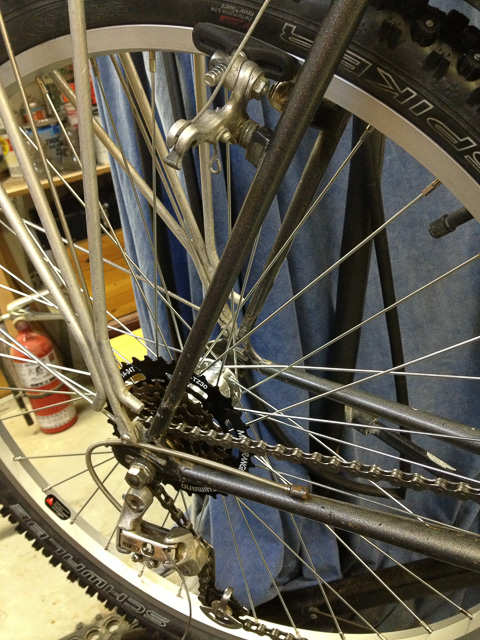
    New read wheel, freewheel cassette, chain & brake pads. New derailleur shows up later to complete the package.
    New read wheel, freewheel cassette, chain & brake pads. New derailleur shows up later to complete the package.


  • Winter Riding

    Yesterday was the first challenging ride of the winter due to some freezing rain in the early morning. Probably the most challenging part was getting off the driveway! However, the studded snow tires on the bike are awesome compared to the knobby mountain bike tires or the slicker commuter tires I’ve been using up until the first snow fall. 

    I was cautious for the first few kilometers and then began to feel more confident in the studded tires capabilities. At one stop sign I got a reminder on just how slipery it was when I put my foot down for a full stop and just about wiped out. The Schwalbe Ice Spiker tires are worth every penny, highly recommended.

  • Homeward Hustle

    Such a nice sunny warm fall day I was motivated to put a little power to the pedals. Not bad for a 30 year old steel mountain bike with loaded panniers, not to mention the (ahem) age of the rider.

  • It isn’t pretty.

    Just reading up about training with a power meter for road cycling and ended up on Joe Friel’s blog where he is discussing the issues and challenges of “old” or “aging” athletes. Here is his take on the things that your aging body can do to you.

    Joe Friel

    For the purpose of this discussion let’s say that one is “old” over age 50. By this age it is usually apparent that an athlete is experiencing several life- and performance-altering physical changes: lower levels of testosterone, lost muscle mass, increased risk of osteopenia and osteoporosis (especially in cyclists and swimmers), an increased tendency for acid-base imbalance further contributing to bone and muscle loss, a greater propensity for weight gain, lost soft tissue elasticity with an increased likelihood of injury, reduced enzyme activity, less tolerance for heat, and more. It isn’t pretty.

    I’m thinking that “old” is way beyond 50 for sure, but some of the changes can be quite challanging to accept or adapt to for sure.

  • Sorry Lady

    Just wanted to say I’m sorry to the lady who yelled at me from her car on Assiniboine Ave this morning after I made a radical lane change in front of her car on the Queen Elizabeth Way bridge.

    I know I surprised you and you didn’t see me coming until the last second. It was all my fault. I made a bad decision. I’m sorry.

    I heard you say “Are you trying to get yourself killed?”, well the answer is “No”. If you had hit me you would have been trying to rear end that car in front of you. I’m sure you weren’t trying to do that either.

    I cycle that route every day so there is a chance we’ll see each other again. I made a mistake. I’m sorry and I hope you’ll forgive me and give me a second chance.

  • Tires & Mechanicals

    A while back the original tires on my road bike were starting to look a little worn, so I replaced them with a nice looking set of Michelin Pro 3 with a red sidewall that matched the bike paint job nicely. Then I started to notice I was getting more flats, a lot more flats. For a while I chalked it up to just the luck of the ride. Then one ride at the lake I flatted 3 time in under 70km and had to call for a pickup as I’d gone through all my spare tubes! Time to try something different. 

    After some research I settled on trying a Continental 4000S as the new rear tire. Amazingly enough, 6 long rides later, including 4 in the Kenora area where there is lots of sharp granite piece on the road shoulders, not to mention numerous other road debris hazards, and 14km on some serious gravel, all without a single flat!

    So I’m convinced that the Continental is the tire for me an I’ll be ordering another for the front right away.

  • Darn you Strava

    Once upon a time going for a ride was a simple thing, relaxing, no stress. You could ride easy, go hard, or anything in between.

    And then there was Strava.

    Strava has an iPhone app that allows you to track your ride and then upload it to their web site. It also has the concept of “segments” which allows you to compare yourself to anyone who rides the same route as you did. Each segment has a Leaderboard which shows your stats in comparison to other riders who have ridding the same strech of road. You can even get notified when your friends do a ride and when somebody beats your time and steals you KOM (King of the Mountain) status! If you’re at all competitive, like most guys, this is quite annoying, at least it is to me and the first thing that comes to mind is how can I get that 1st place back and beat the other riders time.

    So much for relaxing rides. Now when I ride I’m thinking about “Is this a segment?”, “Who is the leader?”, “How much harder do I need to ride to get a (PR) Personal Record, move up the Leader Board, or reclaim the KOM?”

    On vacation this year I’ve been doing most of my riding in the Kenora area. There is another rider in the area using Strava, and he is killing me! Stole all my KOMs, beats all my times by MINUTES! I find my self trying to close the gap or get some records back, but so far I just can’t do it. I’ve subsequently learned that he is a Cat 3 racer, and of course much younger that me, so I’m trying to console my self with these overriding factors. Even so, I’m still trying to close the gap.

    Yesterday, I intentionally turned of Strava for a good portion of my ride. I actually took the time to look around and enjoy the scenery, which is quite fantastic in the Lake of the Woods area, instead of focusing on the power meter, time, and speed. That part of the ride was much more relaxing and a mix of solid efforts with perhaps somewhat long recovery periods.

    All in all I’m hooked on Strava and I’m sure that most rides I’ll use it. It can keep you motivated and turn an average ride into more of a killer workout. Besides, it’s always fun to steak somebody else’s KOM!

  • One thing leads to another

    IMG 0652

    I’ve been geocaching for a few years, but lately it’s taken a bit of a back seat unless I’ve got lots of time, or I’m out at the lake. Since we’re out at the lake on vacation for a couple of weeks, I assembled a bit of a list of geocaches that you need a boat to access. This generally makes for a nice adventure out on the lake.  This cache, Swimming With Karma – Hay Island, is near our cottage and I thought I’d give it a go. It had an extra appeal in that it mentioned The Thor Occurrence, a gold mine, or an “occurrence” of gold on the lake.

    After finding the cache, I headed over to Pipestone Peninsula to visit “Thor”

    Some info on The Thor Occurance

    Location: Pipestone Peninsula, Manross Township: NTS 52E/9SW Lat. 49’37’02” (49.6171 0 ) Long. 94″21’57” (94.3659 0 )

    Access; Mining location S135 is on the southern part of Pipestone Peninsula, 4 km east-southeast of Pipestone Point. It is accessible by boat from Kenora or from Sioux Narrows.

    Geology: The uppermost part of the Bigstone Bay tholeiitic sequence in the vicinity of Witch Bay consists of south-facing basalt interlayered with peridotite and gabbro sills. The periodotite and gabbro are closely related, with the gabbro apparently forming the upper part of a differentiated sill, similar to that described by Davies (1978) at Shoal Lake. Overlying the tholeiitic sequence are calc-alkaline dacitic and rhyolitic volcanics, mainly tuff breccia and lapilli tuff.

    After wandering around the site I came across a trail that was a little over grown but marked with orange tape flags. Curiosity struck and of course I needed to follow the trail to see where it went. After several kilometres, the trail was getting better and better. As I rounded a corner, the trail is now totally clear and it is apparent that somebody has sprayed the trail with defoliant. My conclusion is that there are a few cottages on the island and somebody has created a quad trail that goes al over the island. I had originally thought that the trail would loop back to where I started, but not so. I pop out to the shore line and realize that I’m a long way from my boat and not heading ay closer. Thanks to the GPS I re-work my route a bit and get back to the boat without retracing my 5-6km hike.

    Back at the mine site, I do a little more exploring on discover several excavations and this automotive frame pictured here. It was hard to tell is it was a car or a truck as there was virtually noting left, no motor, no door panels, just the front fenders and the frame.

    On the way back, I stop at a nearby beach to cool off with a swim and then boat back home. All in all a good adventure.

  • Rode with Hincapie

    On the weekend club ride, we had a couple of “special” guests.

    The other special guests were the Woodcock Race team that joined up with us at Lockport. The FOG fast group went off with them to Selkirk, and then from Selkirk to “The Big Bridge” Tim & Don pulled the train at 46-48km/h and most of us just hung on for the ride, it was a good time. Then, after the sprint to the top of the bridge, the Woodcock team went on a head as we stopped to re-group. The ride boss was pushing for some extra mileage and the group was willing, so it was off to Cooks Creek and then a stop at the beach in Birds Hill Park for water. With riding from home to the Legion and all the way back to the house it racked up 145 km for the day.

    Good preparation for the Muddy Waters 100  (160km) coming up on August 12, 2012. This year the route is a little different with the start from Kildonan Park. The 1st loop is out to Lockport and back via Henderson and Highway 202, and then ti’s the standard FOG route, including Cooks Creek and 1 1/2 laps of Birds Hill Park to round out the 100 mile course.

    Habitat for Humanity is sponsoring the ride and it’s a fund raising event. If you’d like to support them, and me, a tax-deductible donation can be made here, or by using the form in the sidebar.

    If I reach or exceed my goal, I’ll get a cool cycling jersey to add to my collection as a small perk for me, so thanks for your generosity towards this worthy cause.

    Actually, I didn’t ride with “The” George Hincapie, but it made for a catchy title.

  • With a little help from my friends

    I thought I knew how to change a flat, and I do, but last Saturday I learned a lot more. I learned how to do it with the help of friends.

    It was the first official FOG ride of the year and we were about 45 minutes in and just about to turn off Main St back onto River Road and the bike was feeling a little funny. Just after the turn it was for sure the dreaded flat on a group ride. Protocol has everyone stop and wait for the flat to get fixed, so there is a little pressure to get it done quickly.

    Flying through the change the tube is out, wheel and tire checked quickly and new tube installed an re-inflated. Just as I’m putting the wheel back on the bike I notice it’s flat again!

    Lesson #1: Be quick and careful.

    One of my friends has a very close look at the tire by turning it inside out and flexing it back. This process discovers a small piece of glass which is pried out. Now we’re ready for another tube.

    Lesson #2: Have lots of the right tubes.

    I have a 2nd tube with a short stem and the new rear wheel with the Powertap has a deep rim. Friends to the rescue as I’m given a tube. A quick but careful tube and tire assembly followed by a CO2 inflation and we’re good to go.

    Another 30-40 minutes go by and it happens again! Another flat! Frustrated I call for a pickup but the friends insist that they will help get me on the road again. A close look at the wheel shows that the rim tap has moved leaving 3 exposed spoke holes that most likely caused the tube to puncture. Another friend supplies the solution with self adhesive tube patches to cover over the spoke holes. Another friend supplies another tube and while inflating with a borrowed frame pump because i left mine at home, I hear the dreaded psssssss sound. The metal valve stem has snapped! Unbelievable!
    I’m given another tube and this time all goes well and were back on the road.

    Lesson #3: Know your equipment.

    The rest of the ride was uneventful. I’m the only one who flatted, the only one to delay the ride, twice, both for an extraordinarily long time.

    Lesson #4: Always ride with friends.

    Thanks to everyone who helped me get through the ride, gave me tubes, patches, pumps and offered encouragement. Thanks to all who waited patiently.

    20120405-093046.jpg