It’s August 2013 and it’s backing up. Never happened before. Another cottage 1st. The “it” is the septic field.
This is not a good thing.
The fluid from the rectangular settling tank is not flowing out into the field. This pretty much puts the cottage on high alert as everything that flows into the tank is about to start spilling out all over the yard.
After probing with a garden host to try an clear any unknown/unseen blockages with out any success, I decide that we really need to dig into this problem a little deeper.
Repair Stage #1
After digging from the settling tank to the header pipe and across the header a bit I decide to cut out some of the pipe to gain better access to the pipes going out into the field in an attempt to flush them out. In the photo black pipe is the old stuff and white is the new. The flushing seems to be effective so I splice back in the new white pipe and call it a day. Time will prove that this was not the complete answer.

I invited the guys to the boat show. We saw some impressive water craft. Drooled over some ridiculously expensive fiberglass. Went out for wings and a beverage and talked about stuff.
And then, the next day, it started.
There were a few more discussions and then today we’re in a store looking around. Parker saw lots of cool stuff and had to get into, or on to most of them.
But we really knew what we were looking for and after some discussions about the colour we close a deal on one of these bad boys.
With a trailer and a few accessories. Now somebody is shopping for some more add on gear.
Going to be some fun times at the lake this summer.
This last week on vacation I tackles a few cottage maintenance projects. Some required by the passage of time, some required by this years unusually high water levels.
Post Replacement
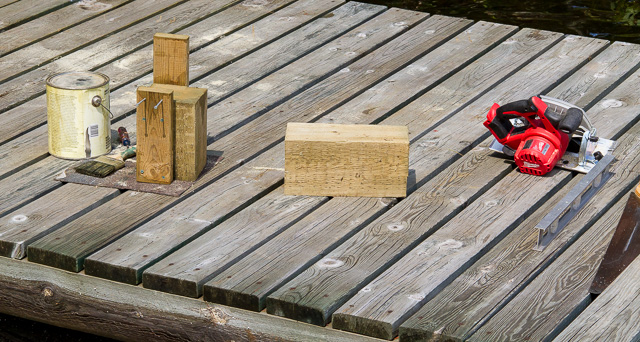
The first was to replace a post that had floated away. At the shore end of the newer dock section I suspect that some serious wave action lifted one of the beams and washed out the post. When I built the dock, the post was very far our of the water and with the weight of the beam and deck boards I never thought this would happen and neglected to physically attach the post to the beam. It’s only 9″ long and is a 6×6 so it didn’t need any bracing. So, today it’s cut a new post, jack up the beam, insert and attach the post to the beam.
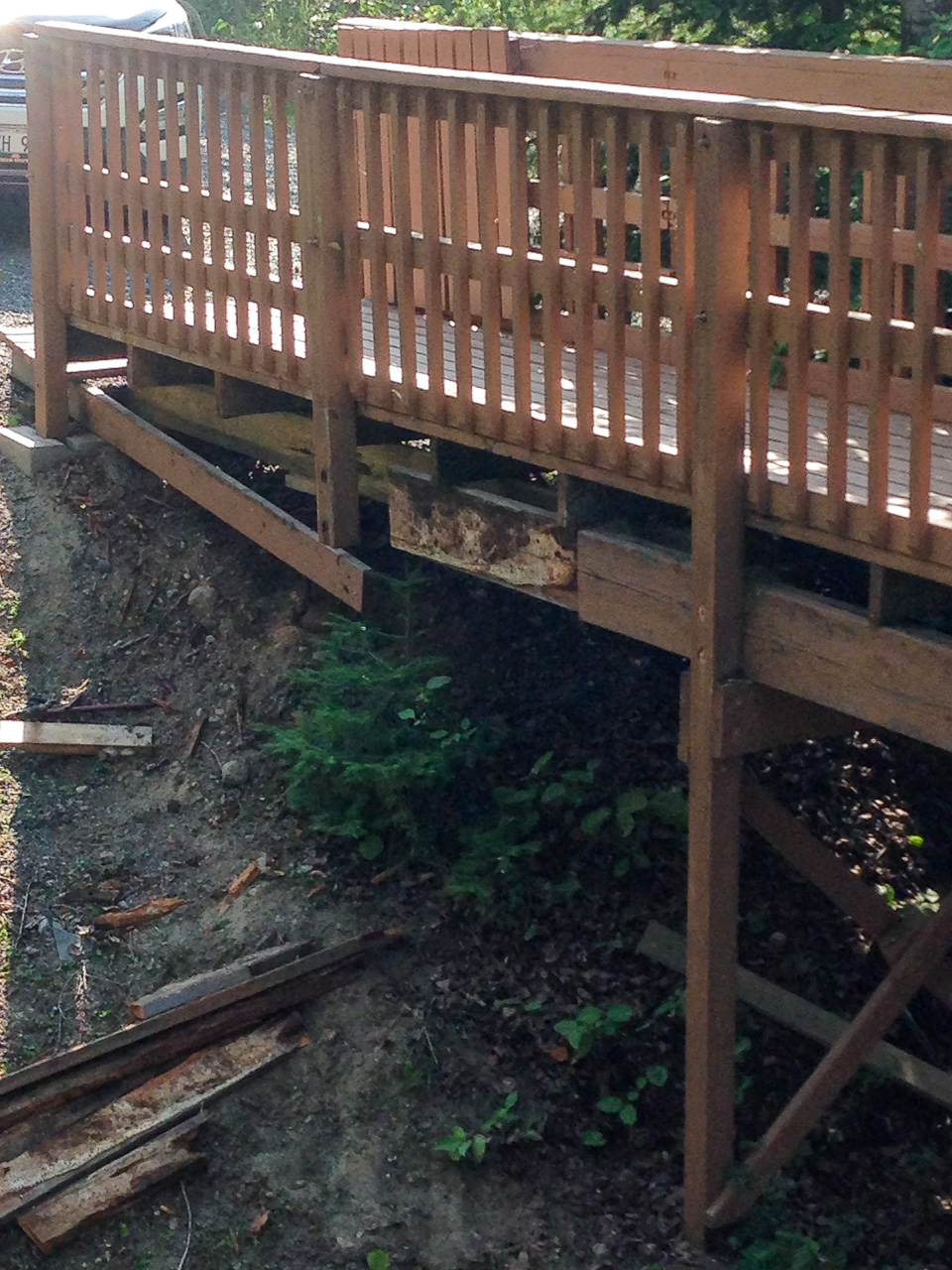
The next project is to replace a section of joists that support the walkway from the driveway to the upper deck at the back of the cottage. Apparently we didn’t use pressure treated lumber on this project originally, over 30 years ago, and time has caught up with us.
Out with the old and ready for the new
Wood rot has claimed a good section of two 2x10s at the driveway end. I put in a temporary 2×8 to support one side of the walkway and then unbolt the railing posts and the 2×6 extension boards that support the initial step. Then two offset cuts to remove the bad 2x10s and form a splice for the new pressure treated 2x10s. Bolt it all back together, remove the temporary support and voilá, good for another 30 years, at least this section anyway.
The next project is a little more challenging. The old section of the dock is tilting down on the shoreward side, quite a bit.
It seems that the crib under the dock has shifted/compressed over time dropping down 4-6 inches. Since the upper deck rests on this edge, it has inherited a bit of a downward slant as well. After pulling up a few deck boards it seems I did a great construction job here and toe nailed all the deck joists to the top of the old dock section. This will make it very difficult to separate from the dock which was Plan A. Plan A was to lift up the deck, then raise up the joists on the crib to level the dock and then lower the deck back onto the dock. Oh well, Plan B.
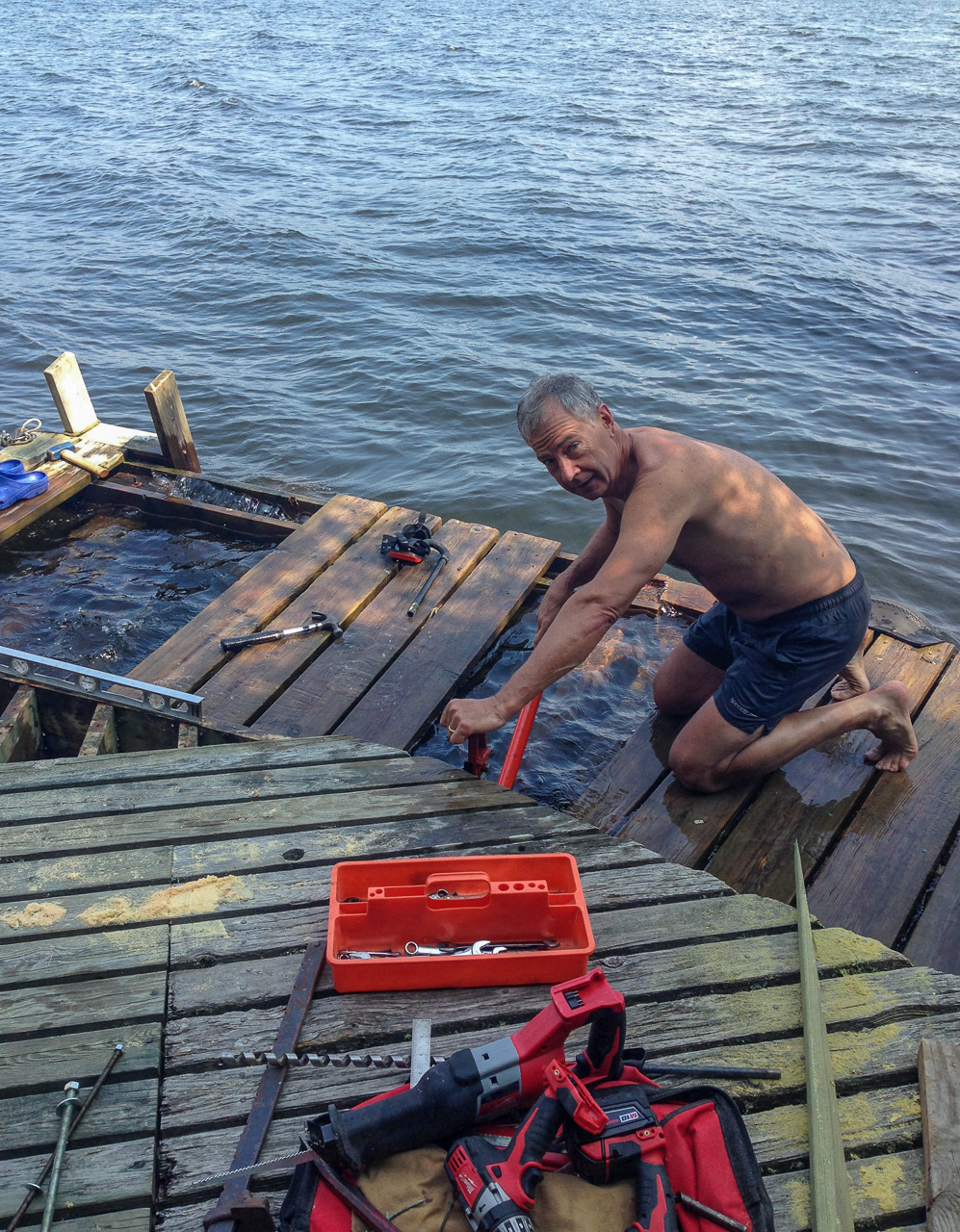
Hard at work fixing up the dock.
Plan B, after swimming around end checking out the crib is to jack up each end of a crib timber and raise both the dock and the deck at the same time. This required cutting out several dock boards to get access, but is successful in the end.
It was a fairly warm day and the water was about 74°F so it was quite enjoyable to work in a bathing suit and be in and out of the water. Plus with the high water levels boat wakes were keeping the top of the dock pretty wet most of the time.
Part way through the day my super-duper cheerleader and awesome wife delivers a dockside lunch that is just fantastic and we take a break to enjoy the sunshine & view.
The whole thing turned out to be pretty much an all day job with many trips up to the cottage for more tools, lumber etc. Once the repair is completed, boards replaces and everything is cleaned up it’s time to call it a day.
As part of the Kenora Arts Project Arts Fest this year there are displays all over downtown Kenora entitled “Muskies on Main”. Here are a few of my favourites.
First off, I’m at the lake, so how sweet is that! Next, it’s not raining and I got in a ride with Arthur Fast instead of the usual solo effort. I did flat on the way out to our 9am rendezvous at Tim’s East in Kenora but still made it on time after donating a pint to the mosquitos on the side of the road. We did an all over the place route that was lots of fun.
After we split up in downtown Kenora it was the traditional stop at Starbucks Safeway for a beverage. Then it was an attempt to improve on the Starbucks to Storm Bay Road Strava segment. I gave it a good shot, but there was a strong head wind all the way. Once at the cottage a dip in the lake to cool off, a nice chicken sandwich made by Shirley and a beverage all while soaking up some beautiful sunshine. Then a “nap” followed by steak, baked potato, mushrooms, Caesar salad and likely a movie. Awesome longest day of the year.
This is the 4th weekend in a row at the lake. It’s quiet, just Shirley and I. The lake is calm with a high overcast and about 10°C. A fishing boat went out at day break (~5:30am) and other that that, very still, very quiet, peaceful. This is the “bug” weekend. The May flies that are normally closer to the May long weekend have arrived and are swarming around the water’s edge. Fairly thick with bugs, but not as bad as some years. I don’t think there will be much hanging out at the dock this weekend. The good thing is they will all likely be gone by next weekend as they have a very short life cycle.
First highway trip for the new Santa Fe. Enjoyed the ride but now there are bugs on the front and some serious washing up to do when we’re back in the city. Still no XM radio service so that might get checked into when we’re back at the dealer. I think it’s likely an XM setup issue, but it is strange that the radio id is not showing up and the free preview channels are not available. Other that that the Santa Fe is great. Enjoying the extra space, and all the toy that come with the Limited edition.
I’m thinking about a bike ride later today or tomorrow morning but for now it’s coffee in the new recliner and some surfing & thinking.
Last fall just as we were closing the lake down for the season, shutting off the water etc. the septic field decided to stop accepting any new contributions from the holding tank. This is a bit of a problems as in order to winterized the system you need to pump down the main tank into the field. Well, after a little digging around it was clear that this was not going to be resolved in a single day. So, a workaround was performed and we planned to deal with it in the spring.
Fast forward to the spring of 2013 and opening weekend where were expecting to have to deal with the situation, but first verify the problem. I run the hose into the field for over 1/2 hour and no problem! The system is not backing up. Not sure what has happened but glad I didn’t have to figure it out. I watch the system for a few weekends and keep an eye on it during our 2 week July vacation and all is good.
Now it’s late August and as I’m doing one of my random routine checks on the septic system, I notice its backing up again! This time we excavate the pipe into the field and expose the header pipe and notice that its disconnected from the tank system and has a crack in one of the pipes. I decide we need to amputate, so a big section of the pipe system is cut out. This section is quite clogged with “material” so I get that out of the way and having this section of the pipe removed gives me better access to the rest of the pipes in the main portion of the field. I flush these pipes until the water runs clear and get a lot of gunk out of the system. Into Kenora for some new pipe parts but we can’t get exactly what we need. Plan B, pump out the main tank and use it like a holding tank until repairs can be made.
This weekend I’m back with the parts. The new sections of pipe go together fairly quickly and I’m using a rubber connector to hook up to the existing pipe still in the ground. The Home Depot guy gave me a great tip about using the connectors that make it much easier than what I was planning on doing. The pipes are in place and all hooked up and now for the moment of truth. I run the hose into the main pipe and wait and watch. In a few minutes one of the 3 rubber connectors is leaking! A few choice phrases were uttered and I realign the pipe and re tighten the rubber coupling. Again, it’s still leaking! More unkind words. After the 3rd failed attempt at fixing the leak I dig around the pipe a bit more to try and get a better view of what is going on. Well this particular pipe is moe into the main field that the other pipes where connections were made and the “leak” is actually water coming out the hole in the pipe just like it is supposed to do, so there really isn’t a problem at all.
After running a typical flow into the field for an hour it is not backing up, so it appears we’re back in business. We’ll need to watch this for the rest of the season, but it’s looking promising right now. If there is a reoccurrence it will mean digging up each of the 4 main pipes the make up the field and replacing the pipe and gravel etc. A messy job but nothing too bad compared to the $30,000 estimate for a new septic system.
I join ed up with about 12 other folks including Doug L. and Dave M. for this inaugural ride out to Minaki and back for just over 100km. This was my fastest 100km ride ever, thanks to some young guys setting a blazing pace on the way out, and dropping us on the way back. Coming home it was just Doug & I and I struggled to keep up with him, but we kept a pretty good pace going.
The ride was virtually non-stop. A brief break for about 1-2 minutes at Minaki and another 2 minutes when we got stopped by a train on the way back. Had to fight off cramps in both calves on the way out and some serious leg fatigue and stomach muscle aches on the way back, but still a great ride.
On a related note, I’ve noticed a difference in distances being reported by Strava and the Wahoo Fitness iPhone app. The app is using the speed/cadence sensor data and Strava is using the GPS data. Not much I can do about the GPS data, but after checking the app configuration for the speed/cadence sensor, I had the wrong wheel size circumference. So, all this time I’m actually riding farther and faster that I though, well at least a little bit.
On Thursday after breakfast we headed out on the lake for an adventure to explore a unique aspect of Lake of the Woods. During World War II there were six German prisoner of war camps on the lake, most are close to us so we went over to POW (Prisoner of War) Bay to see what remains of this camp and the logging operation that was on place between 1941-1944.
POW Bay
The answer is “not much”! After 70 years the fast growing deciduous trees have reclaimed the shoreline and there is no easily visible evidence that a multi-building camp housing 100-125 men ever existed in this location. The bay is quite shallow and there were lots of weeds as we approached the shore and there was a strong on-shore wind as well. As we got closer it became clear that if might be quite difficult to get the boat out of the weeds if we landed, so with discretion being the better part of valour, we headed back out into open water. It was a hot day and lots of deer flies etc. so an investigation of the camp area will be left for another day.
Apparently, the foundational outlines of several buildings and other artifacts can be found in the area. Perhaps on a cooler day in the fall we’ll make a return trip.
As with any cottage of a certain age, there are a number of quirks that have developed over the years. In the beginning, everything is well-organized or at least planned out and then over time little changes accumulate and it helps to have insider knowledge on how things work, or why things got to be the way they are. I’ve occasionally thought of putting together a “Cottage Book”, a history of our cottage, startup and shutdown procedures, things that are likely to go wrong from time to time and how to fix them. Not sure if and when this fabulous book might make an appearance on the best sellers list, so instead I’m thinking a series of “Cottage Tips” might be more expeditious in terms of sharing my experiences.
Tip #1: The water pump is running, but nobody is using the water.
This is not a good sign, especially if the pump is running frequently and nobody in the cottage is using any water. This is one reason why we turn the pump off when nobody is there. A runaway water pump will burn out sooner or later, and we’re all kind of used to having water on demand, not to mention the cost of replacing the pump. So, what to do? Well, somewhere in the waterline system there is a leak causing he pressure to drop and therefore the pump to kick in. If the leak is inside the cottage, you probably know this already by the water running all over the place. This generally only happens at startup when the lines have not been drained properly and freezing water has burst a pipe. But what if this is mid-summer and things have been fine up to now? Well, if there is no flooding in the cottage, check the area around the pump. Over the years metal pipes have corroded and cracked causing leaks.
No leaks here either? Hmmm, more investigation required. The next most likely culprit is the intake line and foot valve. I’d check the foot valve 1st. This little brass valve at the end of the intake line has a little spring-loaded plunger that keeps the water from draining out of the intake line when the pump is not running. When the pump runs, the valve opens and allows the water to enter. The part that is not too visible is the rubber O-ring on the plunger. Over time, it can get cracked and worn out and start leaking. In some cases, it can break and just “disappear” as it did this year (2013). There are spare O-rings in the shop and it’s a simple job to take the foot valve apart and replace the ring.
First close the valve to the house, just to avoid draining the whole system. Unplug the pump, and drain the pressure off using the hose at the pump. Take the foot valve off the line, remove the plunger, replace the O-ring, re-assemble and re-prime the intake line and plug-in the pump to re-pressurize the line. When the pump stops and the line is fully pressurized, have a look at the foot valve and ensure there is no water spraying out and it’s not making any hissing sounds, which would indicate that it’s still leaking. Assuming all is good, replace the foot valve screen, and take the end of the line back out into the deep water straight out from the dock. Easy eh? Oh yeah, don’t forget to open the valve to the house so you can enjoy the fruits of your labour.
Not the foot valve? Check the rest of the intake line to the pump, and then check the line between the pump and the house, then look around under the house for leaks. Still can’t find the problem? You have a real mystery on your hands. Keep looking, something will turn up sooner or later.